Luxor Temple
The temple of royal coronation and renewal
- 2.7 kmAvenue of Sphinxes to Karnak
- 1830its twin obelisk went to Paris
- 4faiths worshipped on this spot
- 2021the Avenue reopened to visitors
Why it matters
Originally built by Amenhotep III as a temple dedicated to the renewal of the king's divine power, with later additions by Tutankhamun and Horemheb, before Ramesses II added the massive entrance pylon, his colossal seated statues, and his own courtyard. During the Ptolemaic and Roman periods, part of the temple served as a Roman military camp, and a shrine to Alexander the Great — regarded as a divine successor to the pharaohs — was built inside one of its halls. Later, part of the temple became a Coptic church, and the Abu al-Haggag mosque was built above it, still standing today — making the site a rare witness to continuous sacred use across four different religions. One of the two obelisks that once flanked the entrance was gifted to France in 1830 and now stands in the Place de la Concorde in Paris.
Luxor Temple was not just a place of daily worship; it was where pharaohs were crowned and their divine right to rule renewed through the annual Opet Festival rituals. It connected to Karnak Temple via the famous Avenue of Sphinxes, stretching nearly three kilometers, which was fully reopened to the public in 2021 after decades of restoration — allowing today's visitors to walk the same route pharaonic processions once took thousands of years ago.
Plan your visit
| Hours | Daily 06:00 – 21:00 (evening hours can vary) |
|---|---|
| Ticket | Foreign adult EGP 500 Student EGP 250 (valid ID) |
| Photos | Phone photography free |
| Time | 1–1.5 hours |
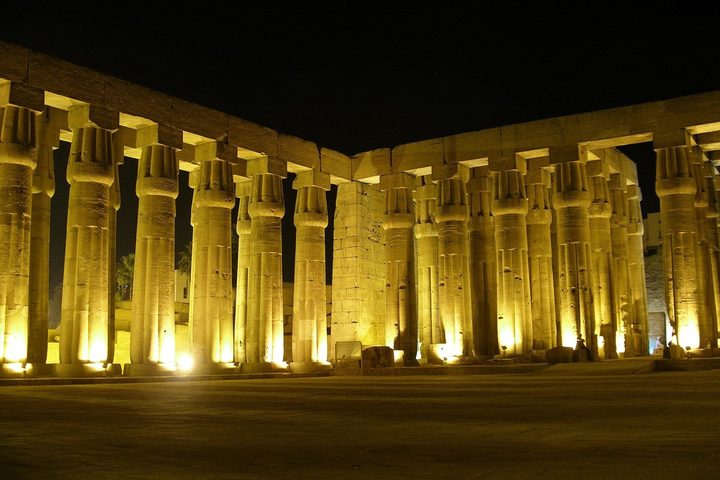
| Best time | Late afternoon into dusk, when the lights come on |
| Where | East Bank, on the Corniche in the town centre |
Prices and hours checked October 2026. Always confirm at the ticket office. Card payment only at most ticket offices.
Your route through Luxor Temple
- 1
Avenue of Sphinxes
The processional road that once linked this temple with Karnak, lined with human-headed sphinxes.
- 2
First Pylon & obelisk
Ramesses II’s great gateway, his seated colossi and the obelisk whose twin now stands in Paris.
- 3
Court of Ramesses II
Look up: the Abu al-Haggag Mosque sits on top of the old court, its door high above the ancient floor.
- 4
Colonnade of Amenhotep III
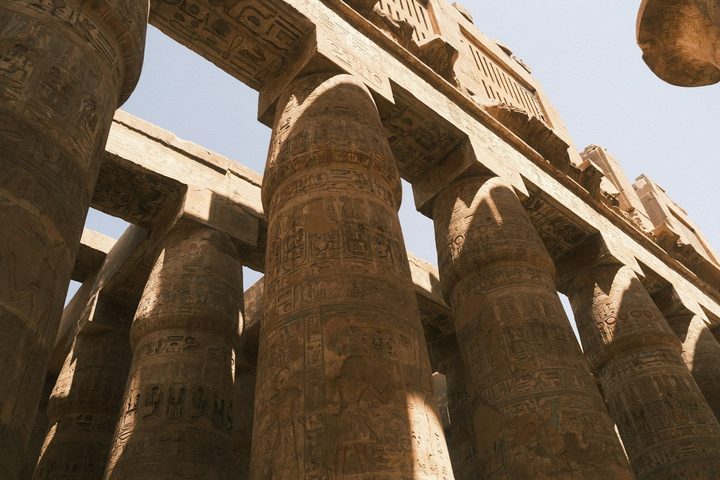
Fourteen giant papyrus columns. The walls show the Opet Festival procession, carved under Tutankhamun.
- 5
Sun Court of Amenhotep III
A forest of elegant columns. In 1989 a hidden cache of statues was found buried beneath this floor.
- 6
Roman chamber & Alexander’s shrine
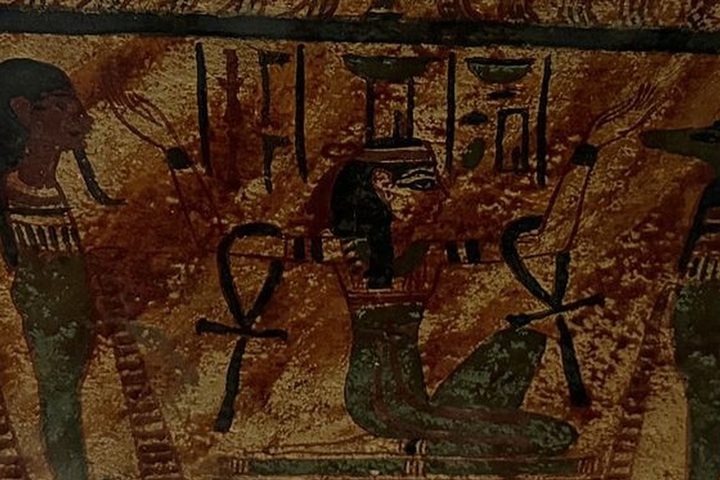
Roman paintings over pharaonic reliefs, and a shrine where Alexander the Great is shown as a pharaoh.
Good to know
- Look for the Abu al-Haggag Mosque above the court — still in use after more than 700 years.
- It is right in town — easy to reach on foot or by horse carriage from the Corniche.
Hear the full story on the free audio guide
Free app, 11 languages, works offline — no signal needed inside the tombs and temples.