Karnak Temple
The largest religious complex of ancient Egypt
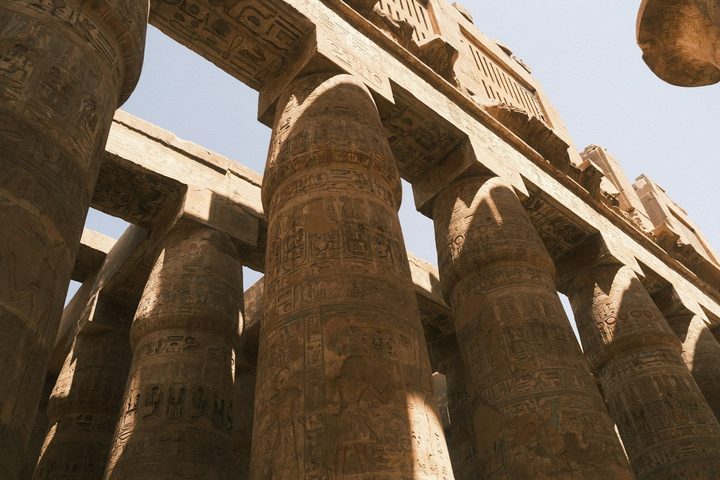
- 134columns in the Great Hypostyle Hall
- 20 m+height of its 12 central columns
- ≈30 mHatshepsut’s obelisk, one of Egypt’s tallest
- 2,000+years as a place of worship
Why it matters
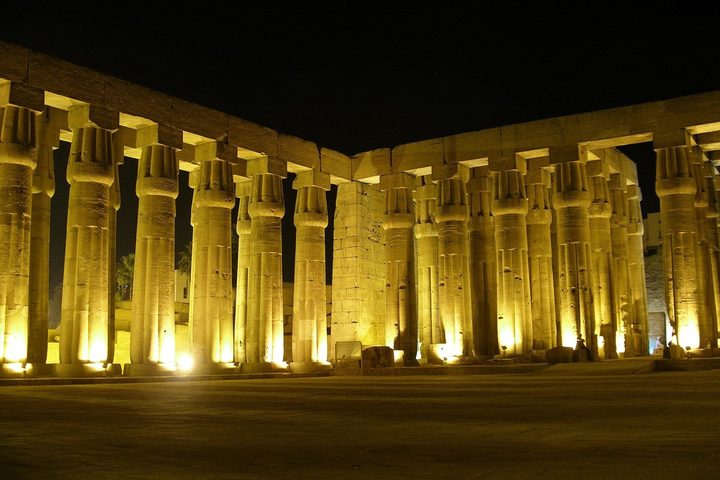
The largest religious complex ever built in the ancient world was not constructed all at once — it grew over more than a thousand years as successive pharaohs added their own layer to what came before. Major expansion began in the Middle Kingdom, but its greatest growth came under Thutmose III, Seti I, and Ramesses II. The Great Hypostyle Hall, begun by Seti I and completed by Ramesses II, contains 134 massive columns, with twelve central columns rising over 20 meters, once supporting a stone roof that blocked out sunlight to create a dim, sacred atmosphere. The site also includes a sacred lake used by priests for ritual purification, and towering obelisks — among them one raised by Hatshepsut standing nearly 30 meters tall, one of the tallest surviving obelisks in Egypt.
Dedicated primarily to the god Amun-Ra, Karnak was the beating heart of religious and political life in ancient Thebes for more than two thousand years. At the height of their power, the priests of Amun controlled wealth and influence rivaling the pharaoh himself, and some historians believe their growing authority contributed to the weakening of central royal power in later periods. Karnak was the focal point of the annual Opet Festival, when the statue of Amun was carried on a sacred barque along the Avenue of Sphinxes connecting Karnak to Luxor Temple, in a grand procession joined by thousands to renew the pharaoh's divine authority.
Plan your visit
| Hours | Daily 06:00 – 17:00 (last entry about 16:00) |
|---|---|
| Ticket | Foreign adult EGP 600 Student EGP 300 (valid ID) |
| Extra | Mut precinct is separate; Sound & Light show EGP 900 |
| Photos | Phone photography free |
| Time | 2–3 hours, unhurried |
| Best time | At opening, before the heat and the groups — or the evening show |
| Where | East Bank, about 3 km north of Luxor Temple |
Prices and hours checked October 2026. Always confirm at the ticket office. Card payment only at most ticket offices.
Your route through Karnak
- 1
Avenue of Rams & First Pylon
Ram-headed sphinxes — the ram was a sacred animal of Amun — guard the way to the huge first gateway, the largest at Karnak and never finished.
- 2
The Great Court
An open court where later kings added their own monuments. Look for the colossal standing statue of a pharaoh with a small queen at his feet.
- 3
Great Hypostyle Hall
134 giant columns, begun by Seti I and finished by Ramesses II. Once roofed, it was kept dim on purpose to feel sacred and mysterious.
- 4
The Obelisks
Two granite needles stand here: one of Thutmose I, and Hatshepsut’s, nearly 30 m tall — among the tallest still standing in Egypt.
- 5
Festival Hall of Thutmose III
At the far east end, Thutmose III’s hall — its tent-pole-shaped columns and carved plants and animals are a quiet contrast to the crowds.
- 6
Sacred Lake & Giant Scarab
Priests purified themselves here before their rituals. Beside it sits a large stone scarab, a symbol of rebirth and the rising sun.
Good to know
- Bring water and a hat — the open courts have little shade; the Hypostyle Hall is the coolest spot.
- Wear comfortable shoes: the route above is roughly 1–1.5 km of uneven ground.
- The Avenue of Sphinxes outside links Karnak to Luxor Temple — about 2.7 km, beautiful at sunset.
- Come back after dark for the Sound & Light show (separate ticket).
Hear the full story on the free audio guide
Free app, 11 languages, works offline — no signal needed inside the tombs and temples.